
Encouraging Scientific Inquiry in Early Education
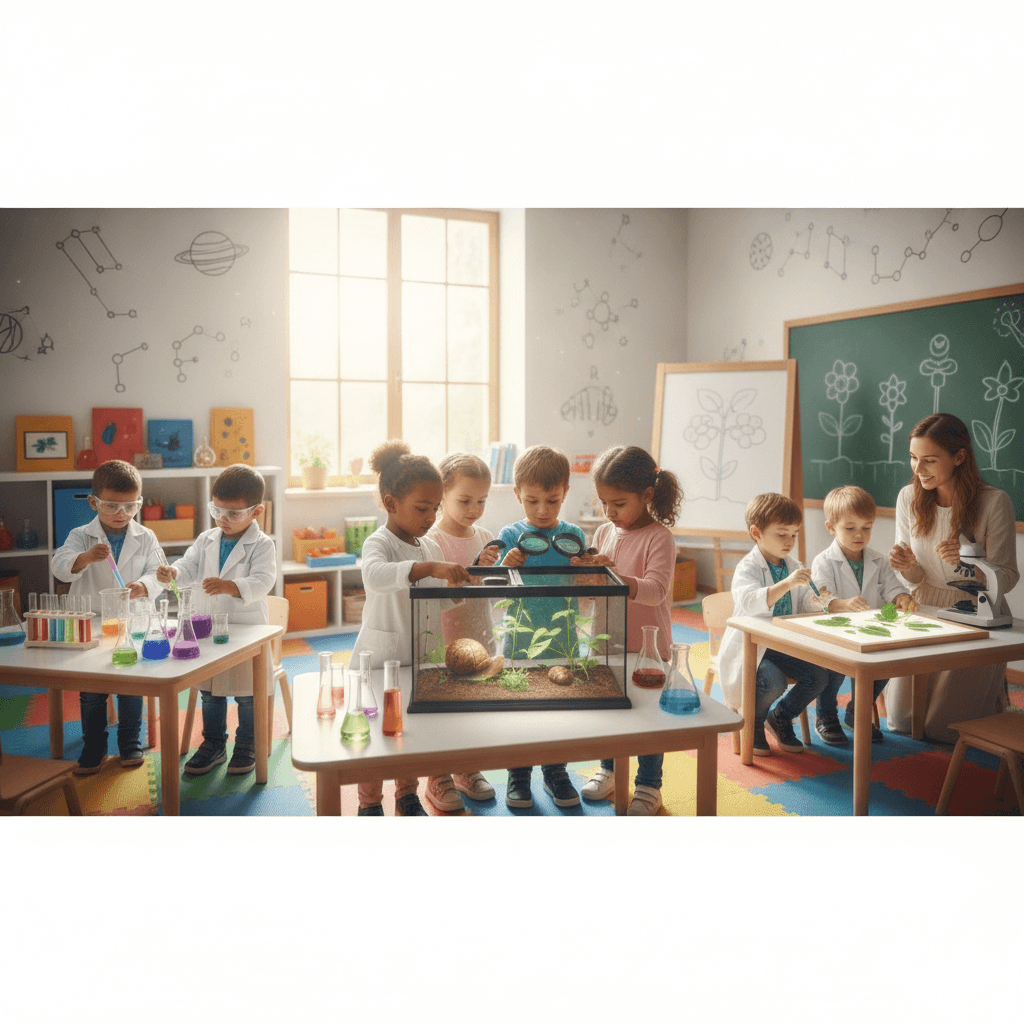
I believe fostering a love for science begins long before a child steps into a formal classroom. Young children possess an incredible natural curiosity about the world around them. They constantly ask “why” and “how” and explore everything with an open mind. This inherent drive for discovery is the perfect foundation for encouraging scientific inquiry in early education.
As parents and educators, we have a unique opportunity to nurture this innate scientific spirit. We can turn everyday moments into exciting learning experiences. My goal is to share practical insights and actionable tips that help transform simple play into powerful scientific exploration. It is about building a mindset of observation and critical thinking from the very start.
I have seen firsthand how simple changes in approach can ignite a lifelong passion for understanding. It doesn’t require expensive equipment or complex experiments. It simply needs a willingness to engage and guide children through their own discoveries. We are planting seeds for future innovators and critical thinkers.
Nurturing Curiosity from a Young Age
Children are born scientists. They constantly observe patterns, test boundaries, and ask questions. I remember watching my own child drop various objects from a high chair, not out of mischief, but to understand gravity and sound. This innate desire to investigate drives their learning every single day.
Our role as adults is to protect and encourage this natural inclination. We must create environments where asking questions is celebrated and exploration is safe. It is about validating their observations and guiding them to find answers themselves, rather than just providing immediate solutions. Simple prompts like “What do you notice?” or “What do you think will happen next?” are very powerful tools.
Observing the World Around Them
Everyday life offers countless opportunities for scientific observation. For instance, watching raindrops slide down a windowpane can lead to discussions about water, surfaces, and speed. A trip to the park becomes a biology lesson when we examine different leaves or watch ants march in a line. We can point out the distinct shades of green on a plant and talk about why they are different. I always suggest focusing on sensory details and encouraging children to describe what they see, hear, touch, and even smell.
Even things like shadows or reflections offer chances for simple observation. We can observe how shadows change size and shape throughout the day. This teaches them about light sources and how light interacts with objects. These small observations build a strong foundation for more complex scientific concepts later on.
Hands-On Exploration and Play
Scientific inquiry truly thrives through hands-on engagement. Young children learn best by doing and by experiencing things directly. This means moving beyond passive learning and embracing active, often messy, experimentation. It builds a deeper understanding than any textbook ever could.
When children manipulate materials, they are testing hypotheses in real time. They learn about cause and effect and develop problem-solving skills. I always advocate for open-ended materials that allow for multiple uses and discoveries. Playdough, water, sand, and building blocks are fantastic tools for this type of learning. They encourage creative thinking and allow for repeated experimentation.
Simple Science Experiments at Home
You can set up engaging science activities with basic household items. Here are some easy ideas:
- Floating and Sinking: Fill a tub with water and provide various objects like a leaf, a stone, a plastic toy, and a cork. Ask children to predict if each item will float or sink and then test their predictions.
- Color Mixing: Offer primary colored paints or food coloring in water. Let children mix them to discover secondary colors. This introduces them to chemistry and observation.
- Baking Soda Volcano: A classic for a reason. Combine baking soda and vinegar in a small container. Watch the fizzing reaction. This teaches about chemical reactions and observation in an exciting way.
These activities allow children to explore concepts like density, solubility, and chemical reactions without needing to know the scientific terms. They are simply observing and experiencing the scientific process in action. Remember to let them lead the exploration and ask open-ended questions about what they see.
Developing Essential Scientific Skills
Encouraging scientific inquiry in early education is about more than just teaching facts. It is about equipping children with fundamental skills that serve them throughout their lives. These skills include observation, prediction, hypothesis formation, and critical thinking. They are the building blocks of scientific literacy and effective problem-solving.
When a child observes a bug, they are learning to pay attention to details. When they guess what will happen if they mix two colors, they are making a prediction. And when they try mixing the colors, they are testing a hypothesis. These early experiences refine their ability to gather information and make sense of the world. I believe these foundational skills are crucial for all learning, not just science.
From Questions to Hypotheses
Guiding children to form educated guesses is a key part of the scientific method. When they ask “Why does this happen?” we can respond with “What do you think makes it happen?” This prompts them to move beyond a simple question and to consider possible explanations. For example, if a child notices that plants grow towards the window, you might ask, “Why do you think the plant is leaning that way?” They might suggest the plant likes the sun. Then, you can explore ways to test that idea.
Testing ideas can be as simple as moving the plant to a different spot or observing another plant in a darker area. The outcome, whether it confirms their guess or not, is valuable. It teaches them that testing ideas is how we learn. It also shows them that it is okay to be wrong, because wrong answers still provide information that leads to new questions and further discovery.
The Role of Storytelling and Literature in Science
I find that storytelling and literature are often underestimated tools in encouraging scientific inquiry. Engaging narratives can introduce complex scientific concepts in a digestible and exciting way. Books can transport children to different environments, from the depths of the ocean to outer space, sparking their imagination and curiosity about natural phenomena.
When children hear stories about scientists, explorers, or even fictional characters solving scientific puzzles, they begin to see science as an adventure. It makes the subject relatable and less intimidating. These stories can highlight the human element of science, showing that discovery often involves persistence, creativity, and sometimes even failure. I often recommend seeking out non-fiction books written for young audiences that explain scientific topics with clear language and captivating illustrations.
Reading about the life of a scientist like Marie Curie or Albert Einstein can inspire children to dream big. It shows them that scientists are real people with interesting lives. These stories teach them that science is a process driven by human curiosity. It is about asking questions and seeking answers. Picture books explaining topics like photosynthesis or the water cycle are also excellent resources. They help visualize abstract concepts, making them more concrete and understandable for young learners.
Creating a Supportive Learning Environment
A supportive learning environment is fundamental for encouraging scientific inquiry. It is a space where children feel safe to explore, experiment, and make mistakes without fear of judgment. This environment extends beyond a dedicated science corner and permeates the entire learning space, whether at home or in a classroom. I believe in providing open-ended materials and plenty of time for unstructured play. This allows children to pursue their own interests and investigations at their own pace.
Creating this environment involves more than just physical resources. It requires an adult who is present, engaged, and enthusiastic about discovery. We need to listen to children’s questions, validate their observations, and offer gentle guidance rather than direct answers. This approach fosters independence and resilience, essential qualities for future scientists. When you want to ensure your child gets strong foundational knowledge and a deeper understanding of scientific concepts, you might consider external support. Enrolling them in Science tuition can provide structured learning that complements their natural inquiry.
Equipping Your Young Scientist
You do not need a laboratory to inspire a young scientist. Many valuable tools can be found around the house or purchased affordably.
- Magnifying Glass: Perfect for examining leaves, bugs, or textures up close.
- Measuring Cups and Spoons: Great for water play, baking, and understanding quantities.
- Droppers or Pipettes: Excellent for fine motor skills and controlled liquid experiments.
- Notepads and Pencils: Encourage drawing observations or jotting down ideas.
- Collection Bins: Simple containers for collecting natural items like stones, feathers, or shells.
These tools empower children to conduct their own investigations. They teach them how to collect data, observe details, and record their findings. Even a simple cardboard box can become a bug house or a science observation station. The key is to make these materials accessible and encourage their use in creative ways. It is about providing the means for them to explore freely.
Connecting Science to Everyday Life
Making science relevant to a child’s everyday experiences is a powerful way to sustain their interest. When they see how scientific principles apply to things they encounter daily, science stops being an abstract school subject and becomes an integral part of understanding their world. I always try to highlight these connections, whether we are in the kitchen, the garden, or simply observing the weather.
Cooking, for instance, is a fantastic chemistry lesson. Measuring ingredients, observing changes in texture and state as food cooks, and understanding how yeast makes bread rise are all scientific processes. Gardening teaches biology, demonstrating plant growth, the needs of living things, and the role of insects. Observing the sky helps them grasp meteorology and astronomy. These activities turn abstract concepts into tangible experiences.
Even a walk outside can become a scientific adventure. We can talk about how different shoes create different footprints in the mud or how puddles evaporate in the sun. These conversations reinforce that science is everywhere. It is a continuous process of observation and discovery. When children see science as part of their daily life, their engagement and understanding deepen significantly. This makes learning feel natural and exciting for them.
Embracing the Wonders of Scientific Exploration
I genuinely believe that encouraging scientific inquiry in early education is one of the most valuable gifts we can give our children. It is about far more than just preparing them for future science classes. We are nurturing essential life skills like critical thinking, problem-solving, and a deep sense of curiosity that will serve them in every aspect of their lives. From the simple act of observing a bug to making a prediction about a floating toy, every interaction builds their scientific literacy.
As I have highlighted, this journey does not require a fancy lab or complex lessons. It thrives in everyday moments. Simple experiments at home, engaging stories about discovery, and a supportive environment where questions are celebrated are all powerful tools. We are fostering a generation of independent thinkers and eager explorers. So, I encourage you to embrace the “why” questions, provide the tools for hands-on discovery, and consistently connect scientific principles to the world around them. Let us ignite that spark of scientific wonder in every young child and watch them grow into thoughtful, curious individuals who understand and appreciate the incredible world they live in. Your efforts will pave the way for their future successes.


The desire to explore does not dim with age. Many seniors today are more active and adventurous than previous generations…

Working with utilities is a critical service that powers our homes and keeps our infrastructure running. But it is also..

There are those that think that through the advancement of different sources of brand-new power, such as Energy-from-Waste together with..

If this was not real, there would certainly be no requirement for website companies. They would not exist. Making money..